The controversy surrounding director Heo Jin-ho’s The Assassins has escalated rapidly since the film’s release. The film, which deals with the 1974 shooting of First Lady Yuk Young-soo during a Liberation Day ceremony, has become the subject of a heated debate over historical accuracy, artistic freedom, and political polarization in South Korea.
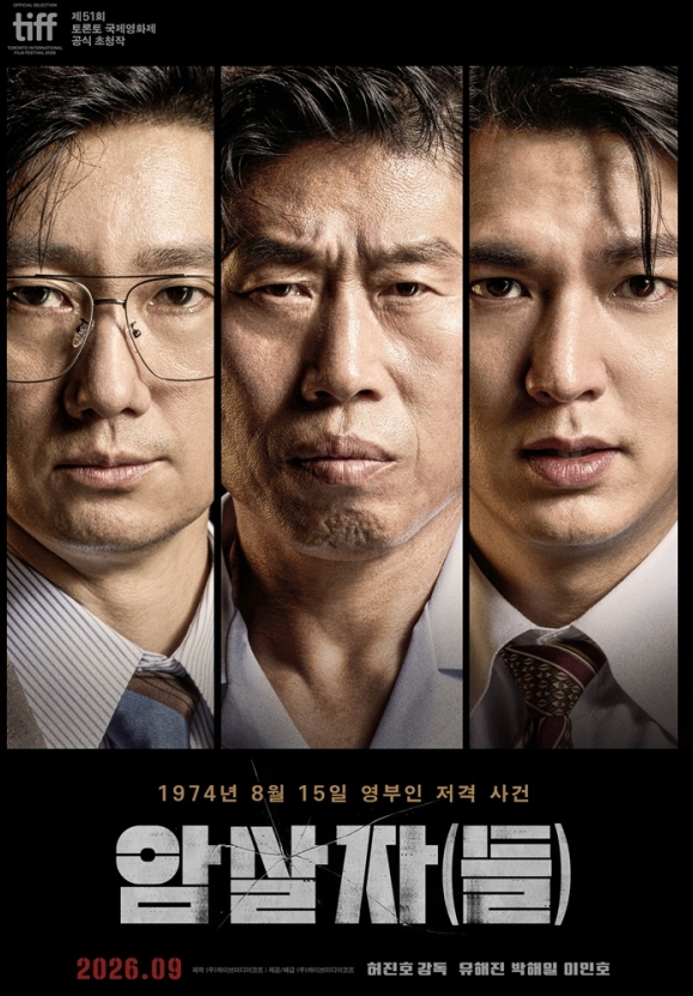
According to the historical account officially presented at the time, Mun Se-gwang, a Korean resident of Japan, fired at President Park Chung-hee during the August 15, 1974 ceremony, while Yuk Young-soo was fatally struck by gunfire. The Assassins does not simply replace that account with a definitive alternative. Instead, it revisits questions surrounding the incident, including disputed or unresolved aspects of the evidence, and uses dramatic reconstruction to explore possible interpretations.
That approach has led some critics and political figures to accuse the film of distorting history or suggesting that forces within the South Korean government, including the Korean Central Intelligence Agency, may have been involved. The filmmakers, however, have said that the movie does not identify any particular person as the mastermind and was not intended to establish a new historical conclusion.
The controversy therefore raises a broader question: Can a historical film raise uncomfortable questions without being treated as a factual claim?
How the Controversy Escalated
The dispute quickly moved beyond film criticism and into politics.
The People Power Party, including party leader Jang Dong-hyuk, has strongly criticized The Assassins, arguing that the film could mislead audiences about the historical record. Political figures have called for measures including a boycott, the suspension of screenings, and the appearance of director Heo Jin-ho at a parliamentary audit.
The Park Chung-hee Presidential Memorial Foundation and other organizations have also called for the film to be withdrawn or for the controversy to be addressed publicly. Separately, former Seoul city councilor Lee Jong-bae reported that he filed a criminal complaint against the director and members of the production team, alleging defamation through false statements.
These are allegations and political actions, not findings that the filmmakers have been found legally liable. Any question of criminal or civil liability should ultimately be determined through the appropriate legal process rather than through political declarations or public pressure.
The production team has consistently described The Assassins as a feature film that combines historical records with cinematic imagination. It has emphasized that the film does not designate a particular individual as being responsible for the shooting and does not present its fictional hypotheses as established historical facts.
Film critic Lee Dong-jin also drew attention to discrepancies within the film concerning the number of gunshots and bullets, arguing that the movie uses such details to encourage viewers to ask questions rather than simply accept a predetermined conclusion.
When Film Criticism Becomes a Political Battle
The central issue is not whether The Assassins should be criticized. It should.
Films based on real people and historical events can and should be examined for factual accuracy, narrative choices, historical context, and the potential consequences of fictionalization. Critics are entitled to argue that a film is misleading, irresponsible, poorly researched, or historically inaccurate.
The more difficult question is what happens when criticism moves from the work itself to political campaigns against the filmmakers.
South Korea is a highly centralized society in which political, economic, media, and cultural influence is concentrated heavily around Seoul. As a result, controversies that emerge in the capital can quickly acquire national political significance. The debate surrounding The Assassins illustrates how a cultural product can become a symbol in a much larger political conflict.
The country’s increasingly polarized political environment has intensified that dynamic. In a deeply divided political climate, the first question is often not “Is this film convincing?” but “Whose side is this film on?”
Once that happens, a movie can cease to be treated primarily as a work of cinema and instead become a tool in a broader political struggle.
Legitimate Concerns, But the Method Matters
The concerns raised by critics of The Assassins should not simply be dismissed.
Those who object to the film argue that fictional portrayals involving real people can create misleading impressions, particularly when the audience may not know which elements are documented and which have been invented for dramatic purposes. They also argue that the reputation of historical figures and the dignity of deceased individuals and their families deserve consideration.
Those concerns are legitimate subjects for public debate.
But the response to those concerns matters just as much.
1. Alleged Falsehoods Should Be Distinguished From Historical Questions
There is an important distinction between presenting a demonstrably false statement as fact and constructing a fictional narrative around unresolved historical questions.
If a film makes a factual assertion that can be shown to be false, that claim can be challenged with documentary evidence, historical research, and legal remedies where appropriate.
But interpreting every cinematic suggestion as a factual assertion creates a much broader problem. Historical dramas often use fictional characters, reconstructed conversations, imagined motivations, and alternative possibilities to explore events that are otherwise documented only incompletely.
That does not mean every fictional interpretation is accurate. It means that fictionalization and factual assertion are not necessarily the same thing.
2. Audiences Should Be Trusted to Think Critically
Another argument sometimes made in controversies surrounding historical films is that audiences may mistake dramatization for historical fact.
That possibility should be taken seriously, particularly when a film involves real people and traumatic events.
But the solution should not automatically be to restrict the film.
Audiences are capable of distinguishing between documentaries, historical scholarship, journalism, and fictional dramas. A mature media environment should provide viewers with access to competing evidence and interpretations rather than assuming that viewers cannot make distinctions for themselves.
If a film’s historical claims are questionable, historians, journalists, critics, and viewers can challenge them publicly.
That process may be more productive than attempting to prevent audiences from seeing the work in the first place.
3. Historical Disputes Should Be Resolved Through Evidence
If The Assassins gets the historical record wrong, the strongest response is evidence.
Historians can examine archival material. Journalists can investigate disputed claims. Researchers can compare contemporary records with later testimony. Critics can identify discrepancies between the film and established scholarship.
This is how historical understanding develops.
Calls for screening restrictions or criminal complaints may sometimes have a place within the legal system, but they should not replace evidence-based debate.
A society committed to freedom of expression should be particularly careful when political disagreement begins to determine which interpretations may be publicly presented.
Beyond Certainty: The Problem of Intellectual Rigidity
The controversy also reveals a broader problem with the way societies sometimes deal with uncomfortable interpretations of history.
People naturally want to protect facts they believe to be established. When those beliefs are connected to political identity, family memory, national history, or respect for a deceased public figure, challenges to those beliefs can feel deeply personal.
But intellectual confidence should not mean refusing to examine competing interpretations.
A willingness to ask questions does not automatically mean rejecting the established historical record. Nor does defending an established account require treating every alternative interpretation as malicious.
The more productive approach is to distinguish between evidence, interpretation, speculation, and fiction.
That distinction allows people to defend historical facts without turning history into a forbidden subject.
The dignity of historical figures and their families is not necessarily protected by closing off debate. In many cases, it is better protected by careful examination of evidence and open discussion.
The Line Between Criticism and Personal Attacks
There is, however, a clear line that should not be blurred.
Criticizing a film is one thing. Targeting individual actors, directors, writers, or production staff is another.
Reports that events associated with The Assassins were canceled or altered amid safety concerns have added another dimension to the controversy. The film’s planned events in Busan, including appearances connected with the Busan International Film Festival and a public screening organized by the Busan Film Commission, were canceled or changed amid the broader dispute.
The Korean film industry has also expressed concern about criticism crossing into personal attacks and the circulation of unverified information about individuals involved in the production.
Those concerns deserve serious attention.
If creators become afraid to work on contemporary or politically sensitive history because of the possibility of organized harassment, the long-term cost will be borne not only by individual artists but by the culture as a whole.
A democratic society must therefore protect two things at the same time: the right to criticize creative work and the right of creators to make that work without intimidation.
What the Controversy Says About Korean Cinema
The The Assassins controversy is ultimately about more than the historical interpretation of one event.
It reflects a difficult question facing Korean cinema: How should filmmakers approach unresolved or politically sensitive history?
There is no requirement that every historical film function as a documentary. At the same time, filmmakers working with real people and real tragedies carry a responsibility to distinguish dramatic invention from established fact as clearly as possible.
The answer should not be censorship.
Nor should it be the assumption that every fictional interpretation deserves unquestioning acceptance.
The better answer is a stronger culture of criticism—one in which audiences can watch a film, historians can challenge its assumptions, journalists can investigate its claims, and creators can defend their artistic choices.
A Call for Restraint
People are entitled to disagree strongly about The Assassins.
They can argue that the film is historically convincing or historically irresponsible. They can praise its cinematic construction or criticize its treatment of evidence. They can believe that it raises important questions or conclude that those questions are based on weak premises.
What matters is how that disagreement is expressed.
A mature public debate requires us to distinguish the work from the people who made it, criticism from harassment, historical evidence from political rhetoric, and cinematic speculation from established fact.
The most important lesson of the The Assassins controversy may therefore not be a definitive answer about what happened in 1974.
It may be a test of how South Korean socie
Peter Yang