Who Is Pastor Jeong Dong-soo? An Enemy of the Korean Church?
Beyond the King James Version Debate: Examining Pastoral Responsibility and the Essence of the Korean Church
The Korean church must be concerned about more than any one pastor. It must also examine attitudes that place personal interpretations above Scripture, elevate particular doctrines or Bible translations above the Gospel, and create division within the Christian community.
The controversy surrounding Pastor Jeong Dong-soo should be examined from this perspective. Simply labeling him an “enemy of the Korean church” does not adequately explain the issues at stake. We must examine what he has actually taught, how church denominations have evaluated his teachings, and how he has responded to those criticisms.
Ultimately, a more fundamental question must be asked: What should the Korean church defend—a particular Bible translation, or the Gospel proclaimed throughout Scripture?
1. Who Is Pastor Jeong Dong-soo?
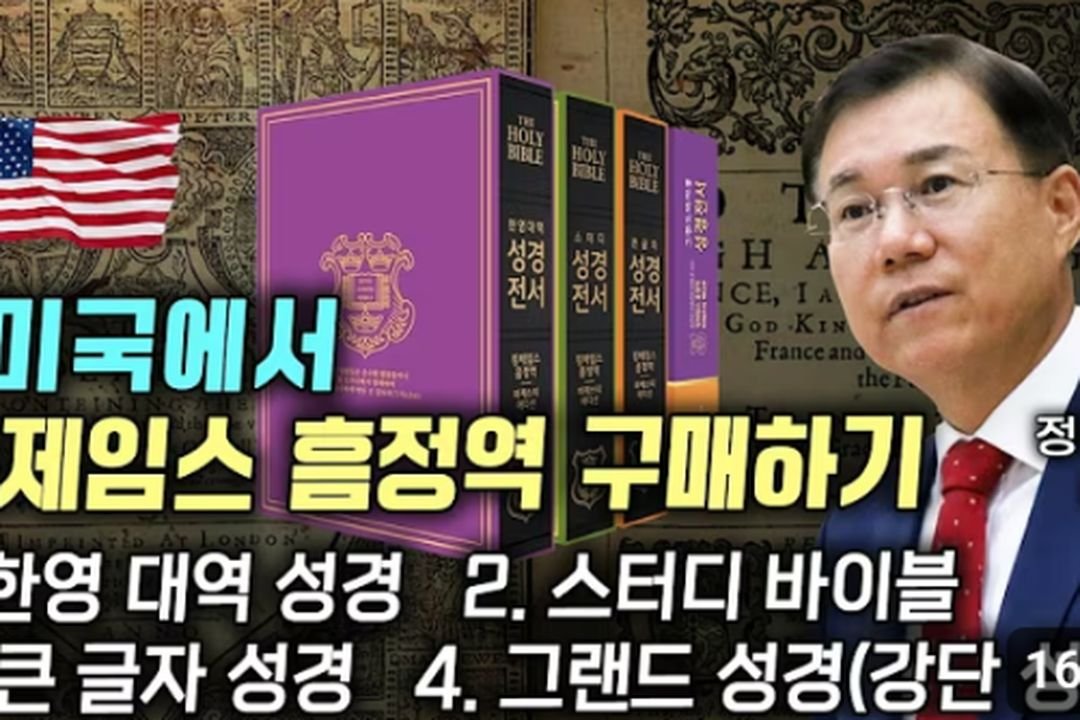
Pastor Jeong Dong-soo serves as the pastor of Incheon Sarang Baptist Church. He has devoted much of his ministry to the King James Version (KJV) and the Korean Heukjeongyeok Bible, emphasizing Bible translation, biblical texts, and the study of Scripture.
It is important to acknowledge that studying the history of Bible translations, examining textual differences, and encouraging people to study Scripture more deeply are not inherently wrong. Comparing translations and discussing their differences are necessary parts of theological study.
The question, however, is how far the emphasis on a particular translation goes. Preferring one translation is different from treating it as the absolute standard of biblical authority. When other churches and Christians who use different translations are judged on the basis of that preference, the debate moves beyond translation and becomes a question of ecclesiology and the nature of Christian faith.
2. Is the King James Version the Only Standard for Scripture?
The King James Version, published in England in 1611, is an historically significant English Bible translation. It has had an enormous influence on English-speaking Christianity, literature, and culture. Many churches and believers continue to use it today.
However, its historical importance does not establish that all other Bible translations are wrong.
The Bible was originally written in Hebrew, Aramaic, and Greek. Churches around the world read the Bible in their own languages, worship through it, and build their faith upon its teachings. Different translations may vary in word choice, sentence structure, and judgments concerning ancient manuscripts. For this reason, comparing and examining translations is an important academic and theological responsibility.
But when one translation is treated as absolute, there is a danger that the tool used to understand Scripture becomes the center of faith itself. We must distinguish between the authority of Scripture and the authority attributed to a particular translation.
In this debate, the essential question is what Pastor Jeong has actually taught. Pastor Jeong has argued that he has never taught that the King James Version is the only valid Bible or that people cannot be saved through other translations. He maintains that his position has been misrepresented as “King James Onlyism.” His response can be found in his official statement.
Therefore, it would be inappropriate to accept only the denominations’ criticisms or to treat the pastor’s response as the unquestionable truth. His original sermons, writings, and lectures should be examined alongside the criticisms and responses.
3. Which Bible Translations Are Used in the Southern Baptist Convention?
Looking at the American church provides useful context for understanding this debate.
Within the Southern Baptist Convention (SBC), the New International Version (NIV) has long been one of the widely used Bible translations. Of course, the entire Southern Baptist Convention does not officially use the NIV exclusively. Individual churches and pastors choose from a variety of translations, including the NIV, NASB, NKJV, and KJV.
A 2004 survey of 700 American pastors found that the NIV, KJV, NKJV, and NASB were all widely represented among the translations pastors used. The results illustrate that even within the Southern Baptist community, there was no single translation serving as the exclusive standard. More information is available in Baptist Press’s report on the survey.
It is important to note that this survey dates back to 2004 and should not be treated as a current measurement of Bible translation use throughout the SBC. In addition, the 2011 Southern Baptist Convention adopted a resolution expressing concerns about certain translation choices in the 2011 revision of the NIV. However, that resolution did not mean that individual churches and believers were prohibited from using the NIV.
The important point is that evangelical churches in the United States have discussed differences among Bible translations without establishing one particular translation as the only standard for every church.
The Korean church should reflect on this reality. Whether it is the NIV, NASB, NKJV, or KJV, a translation is a tool for understanding and communicating the Word of God. No translation should be placed above the Gospel, and no pastor’s interpretation of a particular translation should be elevated above Scripture itself.
A pastor should not be merely a defender of the King James Version. A pastor should be a teacher of the whole Bible and the Gospel of Jesus Christ.
4. The Decisions of the Hapdong and Kosin Presbyterian Denominations
The controversy surrounding Pastor Jeong has moved beyond a disagreement between an individual pastor and other churches. It has become the subject of formal theological evaluation by major Presbyterian denominations in South Korea.
At its 110th General Assembly in 2025, the Presbyterian Church of Korea (Hapdong) considered an heresy-related resolution concerning Pastor Jeong. Questions were subsequently raised about the required voting quorum, and the matter remained controversial. At its 111th General Assembly in September 2026, the denomination revisited the issue and reaffirmed its heresy determination.
The Hapdong heresy committee raised concerns about issues including King James Version exclusivism, doctrines concerning salvation, claims about the relationship between fallen angels and human beings, interpretations involving UFOs, criticism of John Calvin and Reformed theology, and Pastor Jeong’s position on the Apostles’ Creed.
The General Assembly reaffirmed its heresy determination and adopted measures restricting relations with him. Further information is available through CBS No Cut News’ coverage of the Hapdong General Assembly and Christian Daily’s report.
The Kosin Presbyterian denomination also took action. At its 76th General Assembly on September 17, 2026, it approved a petition to classify Pastor Jeong as heretical. The denomination had previously adopted a position of keeping him under observation and refraining from cooperation at its 70th General Assembly in 2020. It subsequently reviewed a theological report at its 75th General Assembly in 2025 before approving the heresy-related petition in 2026.
Related coverage can be found in News & Joy’s report on the Kosin General Assembly.
These decisions should not be taken lightly. Official theological evaluations and resolutions by church denominations carry significant weight for their pastors and members. The fact that two denominations reached similar conclusions through their respective processes demonstrates how seriously this controversy has been regarded within the Korean church.
Nevertheless, the existence of a denominational resolution and the independent verification of every claim contained in that resolution are two different matters. The denominations’ decisions should be accurately reported as their official positions, while Pastor Jeong’s responses and the actual content of his sermons and writings should also be examined.
5. The Church Does Not Belong to a Particular Pastor
The church is not an organization designed to expand a pastor’s personal influence. It is a community of faith with Jesus Christ as its head. A pastor is entrusted with serving that community and teaching the Word of God.
When a pastor turns his own theological interpretation and understanding of the church into an absolute standard, treating other denominations and churches as illegitimate, the unity and catholicity of the church are inevitably weakened.
Christian history has developed through different traditions and theological debates. Baptist, Presbyterian, Methodist, and other Christian traditions have differences in theology and church governance. These differences can be discussed and criticized. But an attitude that suggests one’s own tradition is the only true church undermines the biblical understanding of the Church as one body in Christ.
A pastor does not exist only for the congregation he leads. Beyond his own community, he has a responsibility to the Korean church and the wider Christian community. Rather than turning those who disagree with him into enemies, he should be willing to engage in dialogue within the framework of Scripture and the Gospel.
6. In the Age of YouTube, Pastoral Influence Requires Greater Responsibility
Today, a pastor’s sermons and opinions do not remain within the walls of a church. Through YouTube and social media, they can reach thousands or even millions of people. A theological position can be edited into a short video, rapidly distributed, and used to shape how believers understand their faith and other churches.
In this environment, pastors have an even greater responsibility for their words and attitudes.
If people who do not use a particular Bible translation are treated as spiritually inferior, if entire churches with different theological traditions are portrayed as illegitimate, or if controversial interpretations are presented as established facts without sufficient examination, the consequences extend far beyond a personal disagreement.
Pastors have freedom to express their beliefs, but they must also accept responsibility for the effects their words may have on believers and the church. The greater their influence, the more important self-examination and theological humility become.
The number of YouTube subscribers or video views does not prove a pastor’s theological legitimacy. Popular influence is not the same as biblical authority. A pastor’s authority should be evaluated not by how many people he attracts, but by how faithfully he teaches Scripture and serves the Christian community.
7. Who Is the Enemy of the Korean Church?
So, is Pastor Jeong Dong-soo an enemy of the Korean church?
This question does not require an emotional answer. Labeling one individual an “enemy of the Korean church” may intensify the controversy rather than resolve it. What matters is examining what he has taught, whether those teachings are consistent with the whole of Scripture and the central doctrines of Christianity, and what grounds the denominations have provided for their decisions.
One thing, however, is clear. The Korean church must be concerned about more than a particular pastor. It must guard against attitudes that place personal interpretations above Scripture, elevate a particular translation above the Gospel, emphasize the superiority of one’s own group over the unity of the church, and reject criticism or examination.
The decisions by the Hapdong and Kosin denominations demonstrate how seriously this controversy has been regarded within the Korean church. At the same time, because Pastor Jeong has publicly challenged those criticisms, churches and believers should examine the arguments of both sides and exercise discernment.
What we must defend is neither the reputation of one pastor, the authority of one denomination, nor the superiority of one Bible translation. What we must defend is the teaching of Scripture, the essence of the Gospel, and the unity of the Church in Christ.
Conclusion: A Pastor Must Stand Before Scripture
The Korean church does not need pastors whose primary mission is to defend the King James Version. Nor does it need pastors who uncritically defend the NIV or any other translation. It needs pastors who study the differences among Bible translations, explain those differences honestly, and refuse to make any single translation or personal interpretation absolute.
Bible translations are tools for understanding the Word of God, not the ultimate purpose of faith. We must not place a translation above Scripture, nor should we place personal theological arguments above the Gospel.
Evangelical churches, including those within the Southern Baptist Convention in the United States, have used a variety of Bible translations. This does not mean that differences among translations are unimportant. Rather, it means that those differences should be studied without allowing them to become instruments that destroy the unity of the church or obscure the essence of the Gospel.
A pastor must never use Scripture as a tool for expanding personal influence. A pastor must first examine himself before the Word of God, build up believers through biblical teaching, and demonstrate respect for other churches and Christian traditions.
What the Korean church must defend is not the name of the King James Version. It is the Gospel of Jesus Christ proclaimed throughout the whole of Scripture.
Ultimately, the question does not end with Pastor Jeong Dong-soo.
What is at the center of our churches? A particular Bible translation? A particular pastor? Or Jesus Christ and His Gospel?
It is time for the Korean church to answer that question honestly.
*Images source: Charity Baptist Church, Pastor Jeong Dong-soo youtube