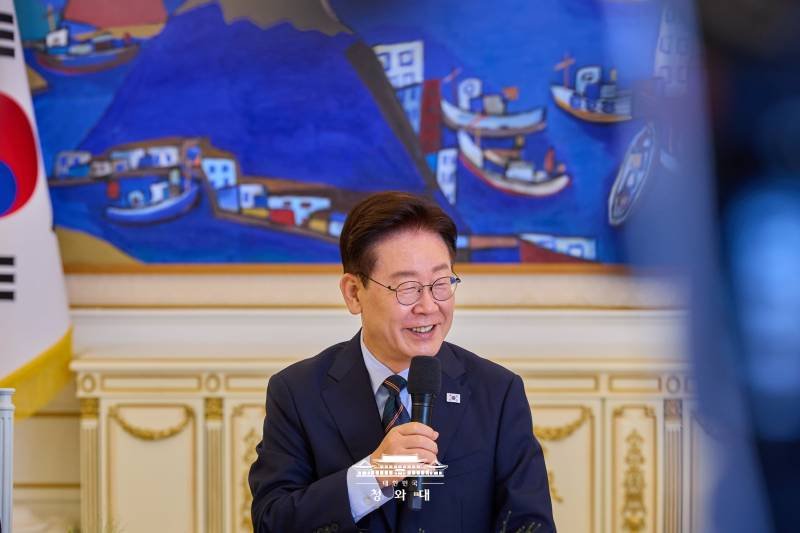
South Korea has an unusual, almost ritualistic pattern: a striking number of its former presidents have ended up in prison, under indictment, or disgraced after leaving the Blue House. Park Geun-hye, Lee Myung-bak, Roh Moo-hyun (who died by suicide amid a corruption probe), Chun Doo-hwan, and Roh Tae-woo all faced prosecution or worse once their terms ended. Against that backdrop, the question of what happens to President Lee Jae-myung once his term is over is not idle speculation — it is almost a standing feature of Korean presidential politics. This piece traces his path to the presidency and lays out, as even-handedly as possible, the legal shadow that still hangs over him.
Who Is Lee Jae-myung? From Factory Boy to Human-Rights Lawyer
Lee Jae-myung’s biography is inseparable from the words “dirt spoon” and “boy laborer.” Born in 1964 in a poor mountain village in Andong, North Gyeongsang Province, he left school after elementary education and went to work in the factory district of Seongnam — grinding through more than twelve-hour shifts at a watch factory and other plants.[1]
- Injury and hardship: He suffered a serious workplace injury when his arm was caught in a press machine, leaving him with a lasting disability.[1]
- Self-taught path to law school: Despite this, he studied for equivalency exams at night, passed them, and in 1982 entered Chung-Ang University’s law school on scholarship.[1]
- Passing the bar: He passed the 28th national bar exam in 1986 and completed training at the Judicial Research and Training Institute. Rather than becoming a judge or prosecutor, he chose the harder, less secure path of a human-rights lawyer.[1]
| Period | Key Milestones |
|---|---|
| Childhood–adolescence | Born in Andong; worked as a boy laborer in Seongnam’s industrial district; passed equivalency exams |
| 1980s | Entered Chung-Ang University Law School; passed the 28th bar exam |
| 1990s | Human-rights lawyer and civic activist based in Seongnam |
Lee Jae-myung as Mayor of Seongnam: Civic Activist Turned Politician
After finishing his legal training, Lee returned to Seongnam and worked as a labor and human-rights lawyer, later leading civic campaigns such as the movement to build a public hospital in the city. In 2010, he was elected mayor of Seongnam, formally entering institutional politics.[1]
- Fiscal turnaround: He declared a debt moratorium shortly after taking office, then worked to clear the city’s debts and stabilize its finances.
- Welfare experiments: He rolled out a youth dividend, free school uniforms, and postpartum care support — policies that drew national attention.
- Communication style: Direct social-media engagement and a reputation for following through on campaign promises helped him win re-election.
Governor of Gyeonggi Province: Lee Jae-myung’s Record of Pragmatic Reform
Building on his mayoral record, Lee was elected Governor of Gyeonggi Province in 2018 — the period that cemented his national image as a hands-on administrator.[1]
- Clearing illegal riverside structures: He ordered the removal of decades-old illegal platforms and tents along Gyeonggi’s valleys and streams, reopening public access.
- Pandemic relief and local currency: During COVID-19, Gyeonggi became the first province to distribute disaster relief payments to all residents and aggressively promoted local currency to support small businesses.
- “Basic society” vision: He advanced a platform built around basic income, basic housing, and basic finance — a new framework for the national welfare debate.
Lee Jae-myung’s Rocky Road to the South Korean Presidency
Lee’s national political career has been anything but smooth.
- 2017 primary bid: He ran in the Democratic Party’s presidential primary and earned a reputation as a blunt, “cider-like” (refreshingly direct) politician.
- 2022 presidential election — narrow defeat: He lost the 20th presidential election by a margin of just 0.73 percentage points.[2]
- Opposition leader amid legal battles: After the loss, he won a National Assembly seat representing Incheon Gyeyang-eul and served two terms as leader of the Democratic Party, weathering prosecutorial investigations and a hunger strike along the way.
He was ultimately elected the 21st President of South Korea — a dramatic reversal of fortune after years of political turbulence.
Inside the Lee Jae-myung Government’s Policy Agenda
The administration’s stated governing philosophy centers on “unity and livelihoods” combined with pragmatism. Its stated priorities include:
- Pragmatic economic growth: Investment in AI, renewable energy, and semiconductors, paired with efforts to revive sluggish domestic demand.
- “Basic society” welfare framework: Expanding housing, financial, and welfare safety nets to address inequality.
- Balanced regional development: Reducing concentration in the greater Seoul area through national development projects.
- National unity politics: Framing governance around cooperation across party lines rather than ideological conflict.
Lee Jae-myung’s Legal Risk: Will the Election-Law Case Resurface After He Leaves Office?
This is where the celebratory version of Lee’s story runs into an unresolved complication — and it is the reason the question in this piece’s title is worth asking seriously rather than rhetorically.
The Election-Law Case Against Lee Jae-myung
The central legal matter is a charge of violating the Public Official Election Act, tied to statements Lee made during the 2021–2022 presidential race — specifically remarks about the late Kim Moon-ki, a former Seongnam Development Corporation official, and about a land rezoning matter in Baekhyeon-dong.[3] An appellate court initially acquitted him, but South Korea’s Supreme Court, sitting en banc, overturned that acquittal last May and sent the case back to the Seoul High Court with an instruction pointing toward conviction[2,3] — specifically finding that his remarks about a golf outing with Kim and about the Baekhyeon-dong rezoning constituted the publication of false information under election law.[3]
After Lee’s inauguration, the Seoul High Court decided to postpone setting a date for the retrial, citing Article 84 of the Constitution, which shields a sitting president from criminal prosecution (with exceptions for insurrection and treason). In practical terms, the case has not disappeared — it has been put on hold, with the possibility of resuming once Lee leaves office.[4]
Diverging Legal Opinions: Conviction Risk vs. Political Prosecution
Views on where this is headed differ sharply along political lines:
- Warnings of likely conviction: Cho Kuk, head of the Rebuilding Korea Party’s policy research institute, has argued publicly that unless the Supreme Court’s legal reasoning is reversed, a guilty verdict is very likely once the retrial resumes after Lee’s term ends. He has pointed to a separate conviction of former president Yoon Suk-yeol under the same election-law provision — decided, he argues, in a manner consistent with the Supreme Court’s reasoning in Lee’s case — as evidence of how the retrial is likely to go.
- Countervailing moves by Lee’s allies: Some within the Democratic Party have pushed to have the indictment itself withdrawn, framing it as a product of prosecutorial misconduct. Critics of that approach counter that withdrawing an indictment on grounds of “fabricated prosecution” would first require an actual disciplinary or investigative finding establishing fabrication — and separately note that, under the Criminal Procedure Act, prosecutors can generally withdraw an indictment only before a first-instance verdict, raising legal doubts about withdrawing a case that is already at the appellate stage.
A Live Constitutional Question: Does Immunity Cover a Pre-Existing Indictment?
There is also an unresolved constitutional debate about whether Article 84’s shield against prosecution while in office was ever meant to cover a case that had already been indicted before the president took office, as opposed to blocking new prosecutions from being filed. Most legal commentators appear to treat ongoing trials as continuing rather than being nullified by the presidency, but the political system has floated legislative proposals to explicitly pause criminal trials for a sitting president [4]— proposals that themselves face constitutional objections on equal-treatment grounds.
Weighing It Evenhandedly: What Happens After Lee Jae-myung Leaves Office
Supporters of the president tend to view the prosecution as politically motivated and the underlying facts as far less serious than the process suggests. Critics counter that the Supreme Court’s own reasoning points toward conviction, and that the unresolved case represents a legitimacy question that will follow Lee for the rest of his term regardless of how the political fight over indictment withdrawal plays out. Given Korea’s track record with its past presidents, neither outcome — quiet resolution or post-term prosecution — can be ruled out at this stage.
Conclusion: Will Lee Jae-myung Survive After Leaving Office?
A man who began as a factory boy and rose through the mayor’s office, the governor’s mansion, and party leadership to the presidency embodies, in many ways, the volatility of modern Korean politics. Whether that same resilience will carry him safely past the legal reckoning many of his predecessors faced after leaving office remains an open question — one that history suggests should not be dismissed lightly.
Source
- Wikipedia, “Lee Jae Myung” — https://en.wikipedia.org/wiki/Lee_Jae-myung Korea Times, “Top court overturns acquittal in Lee Jae-myung’s election law violation case” —
- https://www.koreatimes.co.kr/amp/southkorea/politics/20250501/top-court-orders-retrial-for-lee-jae-myungs-election-law-violation-case
- Korea JoongAng Daily, “Lee Jae-myung headed for second trial after Supreme Court overturns acquittal” — https://www.koreajoongangdaily.com/korea/lee-jae-myung-headed-for-second-trial-after-supreme-court-overturns-acquittal/12228359
- Reuters (via AOL), “South Korea President Lee’s election law violation hearing postponed indefinitely, court says” — https://www.aol.com/south-korea-president-lees-election-032331086.html