A Houston-area electricity consumer filed Complaint No. CP2026080885 with the Public Utility Commission of Texas (PUCT) against Summer Energy, LLC on August 19, 2026. PUCT confirmed receipt and said it would require the company to respond within 15 days. What happened between that filing and the September 24 closure raises a basic question about what “investigation” means in the agency’s informal complaint process.
The claim, and what the company admitted
The consumer’s demand was simple: refund the overcharges based on the corrected usage that CenterPoint had sent for the affected period.
Summer Energy’s written response to PUCT contains a significant admission. For July 2016 through December 2023, its own transaction history did not show corrected-usage transactions. The company nevertheless issued a $2,184.68 refund after reviewing the customer’s calculation, while expressly acknowledging that the corresponding earlier-period transactions had not appeared in its market transaction history.
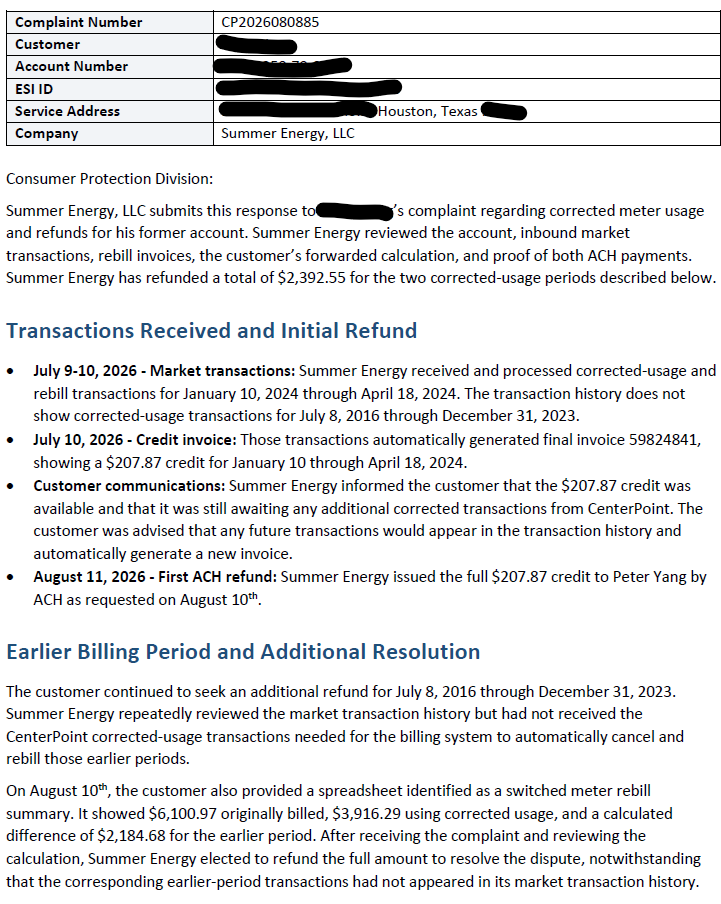
That should have triggered a straightforward question:
If the corrected-usage transactions were not in Summer Energy’s system, what records established that $2,184.68 was the correct amount?
The answer becomes more important because of what happened next.
On September 3, the consumer asked CenterPoint directly what the $2,184.68 represented. CenterPoint responded in writing that the amount was the TDU refund CenterPoint had issued to Summer Energy. CenterPoint also identified two additional amounts — $6.52 and $25.38 — that it had subsequently sent to Summer Energy.
That information does not, by itself, establish that Summer Energy performed no independent calculation. But it does establish that the source of the $2,184.68 was materially different from what a reader might infer from Summer Energy’s description of a refund issued to resolve the dispute.
The obvious regulatory question was therefore not merely whether money had been paid.
It was whether the underlying overbilling had actually been recalculated and corrected in accordance with the applicable rule.
What Investigator Contreras’s determination actually contains
The September 24 determination, signed by Adan Contreras, states that Summer Energy “complied with PUCT rules.” The stated basis was a review of “Summer Energy’s actions, Summer Energy’s tariff, PUCT rules,” with 16 TAC §25.480(d) cited as the applicable overbilling provision.
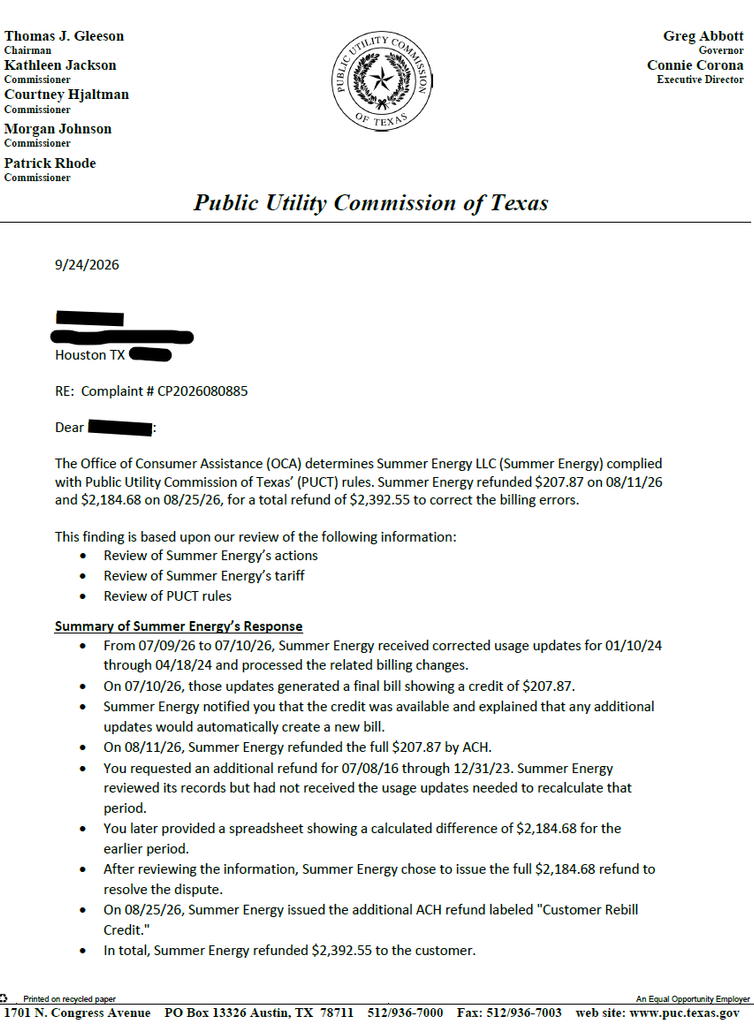
Yet the determination does not show an independent verification of the central financial issue.
There is no documented verification of the underlying transaction history, no documented reconciliation of the $2,184.68 against CenterPoint’s corrected usage, and no documented analysis of the customer’s spreadsheet calculation. The determination’s summary largely restates Summer Energy’s own response.
That matters because §25.480(d) is not simply a rule saying that a company may close an overbilling dispute after issuing a payment.
The relevant provisions address the correction of overbilling, including:
- §25.480(d)(1): correction for the entire period of the overbilling;
- §25.480(d)(3): interest where correction occurs more than three billing cycles after the error; and
- §25.480(d)(4): identification of adjustments by account and billing date or service period when prior periods are rebilled.
The determination does not explain how these requirements were applied to the facts.
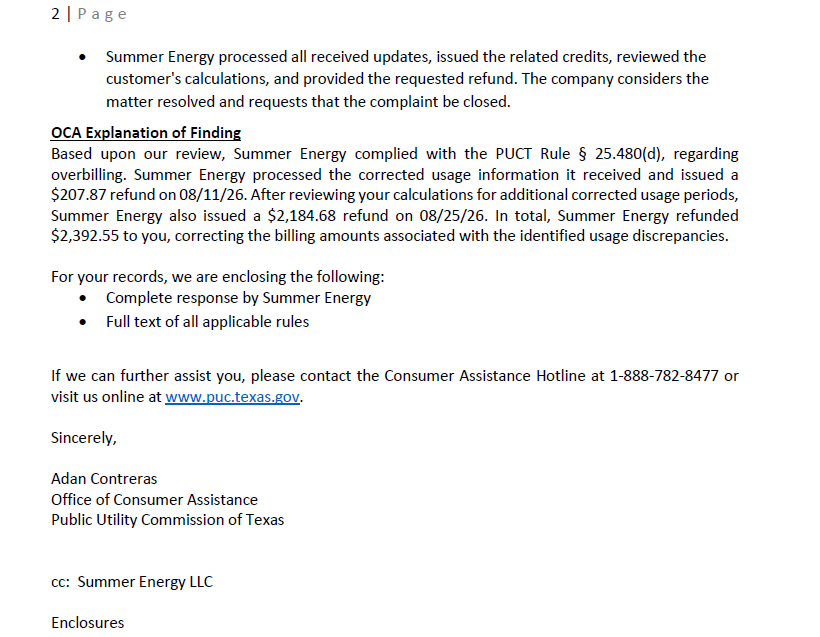
It does not address the absence of corrected-usage transactions for the 2016–2023 period.
It does not explain the interest issue arising from an error extending back years.
It does not explain whether a lump-sum “Customer Rebill Credit” satisfies the applicable identification requirements.
The rule is cited. Its application to the disputed facts is not shown.
The missing September 3 evidence
The most striking omission is timing.
The consumer’s September 3 correspondence with CenterPoint — the correspondence that established the source of the $2,184.68 and identified the additional $6.52 and $25.38 — existed three weeks before Contreras issued the September 24 determination.
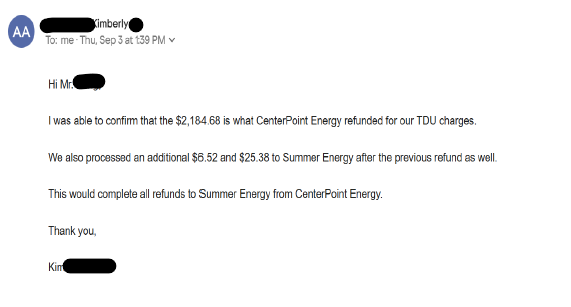
Yet the determination contains no reference to that evidence.
That does not prove that the investigator never saw it.
It does establish something narrower and more important: the determination does not show that the evidence was reviewed or incorporated into the compliance analysis.
For a regulator making a definitive finding of compliance, that distinction matters.
The September 25 response
The problem became even clearer after the consumer submitted a written objection on September 24 containing three specific questions.
The response received on September 25 stated only that Summer Energy had advised that all money had been sent by ACH, including interest. It did not identify the amount of interest, explain the calculation, answer the three questions, or provide supporting transaction records.
Later that same day, the consumer contacted PUCT directly and learned that the complaint had already been closed.
If the record is to be called an investigation, the question is simple:
Where is the verification?
Where is the transaction record?
Where is the calculation?
Where is the reconciliation between CenterPoint’s corrected usage and Summer Energy’s refund?
Where is the analysis showing that the applicable overbilling requirements were satisfied?
A pattern extending beyond one investigator
CP2026080885 is not the only case raising these questions.
In the earlier CenterPoint complaint, CP2026060929, Investigator Kenneth Wilson’s handling shows a similar pattern in the record.
CenterPoint’s response arrived on July 14 at 8:37 PM, and the case was closed on July 17 at 8:40 AM. The recorded review basis was “CenterPoint’s response, CenterPoint’s tariff, PUCT rules.” Consumer-submitted photos and bills were not listed as part of the review basis.
On August 5, Wilson asked the consumer to provide all bills believed to be incorrect “to further investigate” the complaint. According to the record, however, the conclusion that CenterPoint had acted consistently with its tariff and that no interest was owed was communicated the following morning, before those documents had arrived. The objection documents were later forwarded to CenterPoint, the informal complaint was closed, and the consumer was advised to pursue a formal complaint if dissatisfied.
Again, the issue is not whether Wilson acted in bad faith.
The issue is whether a conclusion can reasonably be described as an investigation when documents expressly requested for further investigation had not yet been received when the conclusion was communicated.
Individual, system, or something consumers never see?
There are several possible explanations, and distinguishing among them matters more than assigning blame to an individual employee.
Is this an individual failure?
Is “forward, copy, close” simply how PUCT’s informal complaint process is designed to operate — a paper-review process in which the investigator primarily evaluates the company’s written response?
Or are there structural limitations invisible to consumers — caseload, access to ERCOT or market-transaction data, authority to obtain records, or other constraints — that make independent verification difficult?
The available record cannot answer those questions.
What it does show is that in both cases the company’s response became the central factual foundation of the determination, while the record does not demonstrate comparable independent verification of the disputed underlying data.
That is a legitimate question about regulatory process, regardless of the explanation.
A refund is not the same thing as a verified correction
The distinction at the heart of this case is simple:
Paying money is not necessarily the same as proving that an overbilling correction was accurately calculated.
A consumer receiving $2,184.68 does not, by itself, establish:
- what the corrected usage was;
- what the original usage was;
- which billing periods were affected;
- how the difference was calculated;
- what rates and charges were applied;
- whether the entire period of overbilling was corrected;
- whether applicable interest was included; or
- whether the final amount corresponds to the underlying CenterPoint data.
Those are precisely the questions that an investigation should resolve when the parties disagree about the amount owed.
The question PUCT should answer
The issue here is not whether Adan Contreras or Kenneth Wilson is personally competent, nor whether either investigator acted with improper intent. The existing record does not establish either proposition.
The issue is more fundamental.
When a utility or retail electric provider submits a response that conflicts with the consumer’s evidence, who independently verifies the underlying facts?
And when PUCT declares that a company “complied with PUCT rules,” what evidence and analysis support that conclusion?
In CP2026080885, Summer Energy itself acknowledged that corrected-usage transactions for the 2016–2023 period did not appear in its transaction history.
CenterPoint subsequently confirmed that the $2,184.68 represented a refund of TDU charges paid to Summer Energy.
Yet the September 24 determination does not show how those facts were reconciled with the requirements of §25.480(d).
That leaves consumers with a troubling possibility: a process that looks like an investigation from the outside, but whose public record does not demonstrate independent verification of the facts underlying the final compliance determination.
The question is not whether PUCT should automatically side with the consumer.
The question is whether the regulator should be able to show its work.
If the answer is yes, then the record should show the evidence reviewed, the calculations verified, the conflicting facts resolved, and the specific regulatory requirements applied.
If that record does not exist, consumers are left with a determination — but not the investigation that is supposed to justify it.
Forward. Copy. Close.
If that is not what “investigator” means at PUCT, the agency should show consumers what the investigation actually was.
7 of the Houston CenterPoint Energy Cross-Meter Billing Series
CenterPoint Energy Cross-Meter read previous article
Peter Yang