“paying my neighbor’s electric bill for years — without knowing it.”
A case involving a Houston-area electric customer has drawn attention to a structural gap consumers can encounter in Texas’s deregulated electricity market.
The Discovery: “89-222-453” vs. “89-221-453”
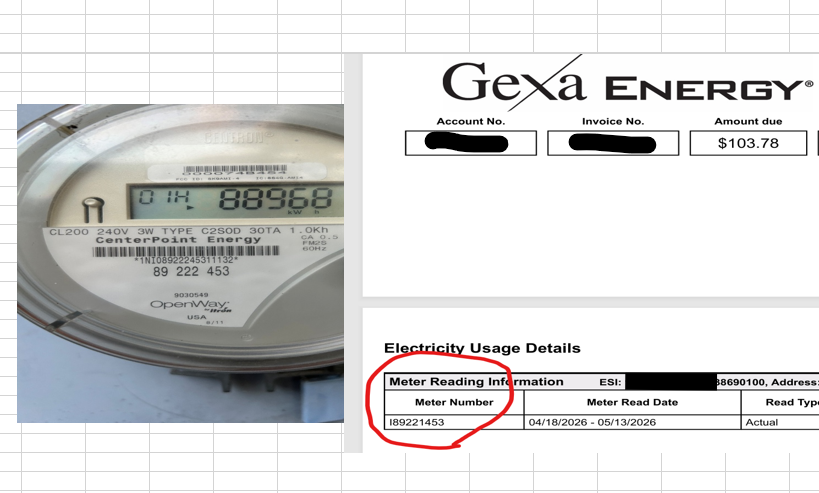
On June 8, 2026, the consumer first discovered that the meter number physically installed at the residence did not match the meter number listed on the billing account. The meter actually installed was 89-222-453, but the billing records showed 89-221-453 — a single-digit difference, but one with significant consequences. In Texas’s deregulated electricity structure, the transmission and distribution utility (TDU) — in this case, CenterPoint Energy — owns and manages meter data. When that data is linked incorrectly, a customer can end up billed not for their own usage, but for a different premise’s usage entirely.
The consumer reported the issue to CenterPoint that same day, June 8. A technician visited the following day, June 9. According to CenterPoint’s later written account, the technician found that the meter number matched company records and closed the matter without further action. The consumer’s own recollection of that visit differs: that the technician acknowledged the discrepancy on-site and indicated it would be corrected. This unresolved conflict between two accounts of the same visit became the starting point for what followed.
Three Weeks of Silence, Then the PUC
After a second report on June 11 produced no response, the consumer filed an Informal Complaint with the Consumer Protection Division (CPD) of the Public Utility Commission of Texas (PUCT) on June 29. PUC promptly opened a case and required CenterPoint to submit a written response within 15 days.
From there, the case took an unexpected turn. On June 30, a CenterPoint representative revisited the premises, confirmed the meter mismatch, and replaced the meter at the consumer’s address. On July 2, the account was rebilled — and the recalculation period was striking: from June 15, 2012, through June 30, 2026 — roughly fourteen years. CenterPoint itself, in effect, acknowledged an error spanning that length of time.
A Response Filed at the Deadline, and a Swift Closure
CenterPoint’s written response arrived at 8:37 PM on July 14 — the statutory deadline. PUC closed the case roughly 2.5 business days later, on the morning of July 17, finding that CenterPoint had “acted consistently with applicable Tariff sections.”
A closer look at the closure letter raises questions. PUC listed only three sources as the basis for its finding: CenterPoint’s response, CenterPoint’s tariff, and PUC’s rules. The photographs and electric bills the consumer had submitted with the original complaint were not listed among the materials reviewed. As of the closure date, the corrected data had still not been transmitted to the consumer’s Retail Electric Provider (REP). And nowhere in the record was a specific refund amount ever disclosed for the fourteen years of overbilling.
The consumer filed a formal written objection the same evening the case was closed.
“Send the Bills” — Followed by a Conclusion 13 Hours Later
About three weeks later, on the afternoon of August 5, the assigned investigator emailed the consumer asking for copies of any bills believed to be incorrect, in order to “further investigate” the complaint. That evening, the consumer replied that the documents were still being gathered and would be submitted as soon as possible.
The next morning, at 7:58 AM — before any of the requested documents had been sent — the investigator emailed a conclusion: CenterPoint had acted consistently with its tariff, and was not required to pay interest on the cross-meter issue. The following day, August 7, the investigator advised the consumer in writing that further disagreement could be pursued by filing a Formal Complaint — effectively closing the informal process.
The Gap Between the Rule and the Response
What makes this case notable is that the consumer independently researched the relevant sections of the Texas Administrative Code (16 TAC) in response.
- §25.28(c): Overbilling must be corrected “for the entire period of the overbilling,” with no time limit. By contrast, underbilling is capped at three to six months. A customer who was overbilled — as in this case — is therefore entitled to a full refund with no time restriction.
- §25.28(c)(3): If a utility fails to correct an overcharge within three billing cycles of the error, it must pay interest on the overcharged amount. Given that CenterPoint’s own account traces the error back to 2012 but did not correct it until 2026, this provision appears to conflict with the investigator’s statement that no interest was owed.
- §25.126(b)(1): A TDU may not back-bill a customer for any period in which that customer was not the customer of record. Whether the consumer was actually the customer of record for the full period dating back to 2012 remains unconfirmed.
Why a Formal Complaint
The informal complaint process is built to resolve matters quickly, largely on the basis of the company’s written response. But when a consumer’s own submitted evidence goes unreviewed, and an investigator reaches a conclusion before receiving the very documents he requested, the process risks becoming a formality rather than a genuine review.
PUCT’s Formal Complaint process works differently: a docket number is assigned, the utility is formally served as a respondent, and a Commissioner rules based on the evidence presented. This case now moves into that next stage — one that may finally answer the questions the informal process left open: the exact refund owed, whether interest applies, the basis for a fourteen-year correction period, and when the consumer’s status as customer of record actually began.
This article was prepared based on complaint records, correspondence between the consumer, PUC, and CenterPoint, and a review of the Texas Administrative Code (16 TAC). Names and identifying address details have been withheld.
3 of the Houston CenterPoint Energy Cross-Meter Billing Series
CenterPoint Energy Cross-Meter read previous article
Peter Yang